Introduction
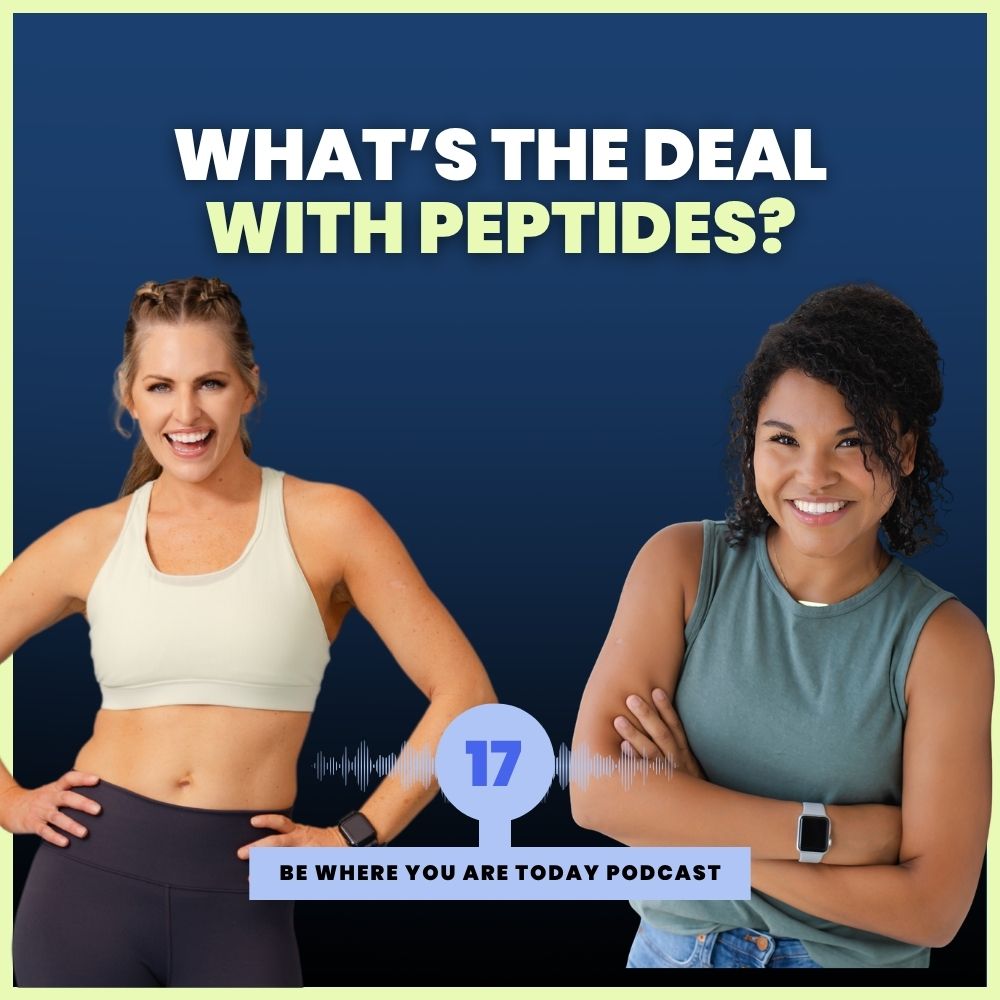
If you’ve been browsing the internet or chatting in fitness circles, you’ve likely encountered the buzz about peptides. Peptides are taking the fitness and nutrition world by storm, but what are they, and why are they getting so much attention? In our most recent episode of the Be Where You Are Today podcast, Vivian and Amy explore what peptides are, their potential benefits, their potential risks, and what’s important if you’re considering them for your own journey. And we’re breaking it all down for you below!
What are peptides?
Peptides are essentially short chains of amino acids, which are the building blocks of proteins. Think of peptides as a bracelet: each bead represents an amino acid, and the string holding them together symbolizes peptide bonds. These bossy little gremlins are crucial for signaling various processes in the body, including hormone regulation, tissue repair, and immune function.
“Peptide” doesn’t automatically mean “supplement,” “performance enhancer,” “fat burner,” or “recovery treatment.” It describes a type of molecule. What a particular peptide does depends on its structure, receptor targets, dose, route of administration, and the evidence behind it.
The Hype and the Reality
Social media has turned peptides into an umbrella term for everything from weight loss and muscle building to longevity, recovery, skin health, and “optimization.” Some of the excitement is based on legitimate science. But the leap from “this molecule has an interesting biological mechanism” to “this will produce a meaningful result in humans” can be enormous.
The recent surge in interest surrounding peptides has been fueled largely by influencers and industry experts touting their potential for fat loss, muscle growth, and anti-aging. But like any trend that promises a miracle solution for all sorts of problems, it’s worth asking critical questions. Are these claims legitimate, or are they part of an overblown hype machine?
Peptides and Fitness: Fact or Fiction?
Many peptides are being marketed as the next big thing in fitness, with supposed benefits ranging from increased muscle mass to faster recovery times. However, while some peptides are backed by solid research, others have little to no human trials to support their claims. In particular, peptides like BPC 157 and CJC 1295 have shown promising results in animal studies, but require more robust research in humans.
Distinguishing the Types of Peptides
Peptides can fall into several categories:
- FDA-Approved Medications: These include insulin and GLP-1 medications like Ozempic and Wegovy, which are well-regulated and have substantiated efficacy and safety profiles. FDA-approved doesn’t mean risk-free. It means we have substantially more evidence about the medication’s safety, effectiveness, quality, dosing, and appropriate use.
- Compounded Peptides: Created by pharmacies under physician supervision, these peptides are less regulated than medications but provide some level of oversight. Compounded doesn’t mean “fake” or just the “generic” version. It means the FDA doesn’t review compounded peptides for safety, effectiveness, and quality before they’re marketed to the general population.
- Research-Only Peptides: Often sold online and marked “not for human consumption,” these peptides are the riskiest, with uncertain quality and safety. Research interest is not the same as clinical evidence.
Are Peptides Right for You?
Before considering peptides, it’s crucial to assess your needs and consult with a healthcare provider. And, a healthcare provider who knows you, your health history, current health status, and any possible contraindications you may have.
First ask: What are your goals?
Are you looking to improve muscle recovery, tackle aging-related muscle decline, or manage weight more effectively? The appropriate intervention depends heavily on the actual problem.
Next, ask: What does the evidence say?
Is there good human evidence for this particular peptide and my specific goals?
Then ask: What are the risks?
Consider:
- Side effects
- Drug interactions
- Contraindications
- Unknown long-term effects
- Product purity
- Dosing accuracy
- Injection risks
- Whether the product is actually what the label says it is
Finally, consider the basics.
Am I already doing the fundamental things that would help me achieve these goals?
- *Resistance training
- * Cardiovascular training
- *Balanced nutrition
- *Appropriate calorie intake
- *Sleep
- *Mobility
- *Rest and Recovery
A peptide shouldn’t be the substitute for any of these fundamentals, nor do these fundamentals become irrelevant when someone is using an appropriate medical treatment like a peptide. In fact, they become even more important.
Peptides in Perspective
While the allure of peptides is understandable, especially for those facing challenges during perimenopause or menopause, it’s vital to remember that no injectable or supplement should replace foundational health practices.
Conclusion: Proceed with Caution and Curiosity
If you’ve followed Amy or Vivian for a while, you know we approach every new trend with both curiosity and caution, and we encourage you to do the same.
As trainers and dietitians, we’re not anti-peptide, and we’re not blindly pro-peptide. We’re pro-evidence.
If a peptide is right for your particular medical situation, has been appropriately prescribed, and is being monitored by a qualified healthcare professional, that’s a very different conversation from ordering an injectable compound online because someone on social media says it will “heal your joints,” “melt fat,” or “build lean muscle.”
The goal isn’t to find the newest shortcut. The goal is to find the most appropriate tool for the individual—and understand both the potential benefits and the risks.
Peptides may be an important part of modern medicine. But they aren’t magic, and “peptide” isn’t synonymous with “safe,” “effective,” or “necessary.”
Stay curious. Ask questions. Look at the evidence. And before putting something into your body, know exactly what it is, why you’re taking it, and who is responsible for your care.
As we continue to monitor the evolution of peptide research, it’s an exciting yet ambiguous time for peptides in the fitness and health industries. Always prioritize safety and scientific backing over hype, and never replace your healthcare provider’s advice with that from unqualified online voices.
Final Thoughts
Join us in the BodyFit Athletic Club, where we tackle fitness trends like peptides with evidence-based discussions. Connect with us for more insightful content, or find our “Be Where You Are Today” podcast wherever you listen to podcasts. Stay curious, stay informed, and always be where you are on your health journey.