

The workout that used to leave you energized now leaves you flattened for two days. You’re sore longer. You’re dragging by Thursday. And somewhere in the back of your mind, you suspect you’ve simply lost your strength and fitness.
Chances are, you haven’t. What’s changed is how quickly your body puts itself back together. Especially if you’re in those magical “midlife” years like me. You’re not broken; your body just recovers differently.
What’s actually happening
Common misconception: We build muscle and strength during the workout. Sure, that’s why we show up and what we are working towards, but true muscle and strength are built during recovery, not during your workout. The workout is the request; the adaptation happens in the hours and days after, mostly while you sleep. And, in perimenopause, two things interfere with that window at the same time.
Sleep gets fragmented. Night sweats, temperature swings, and a 3 a.m. wake-up that won’t let you sleep are common through midlife—and deep sleep is exactly when growth hormone release peaks and tissue repair does its heaviest lifting. You can get seven hours in bed and a fraction of the repair.
Your stress budget shrinks. Exercise is a stress — a productive, positive one, but still a stress. When baseline stress is already elevated by poor sleep, a demanding job, taking care of family, a hormonal system in flux– or all of these together – a hard workout lands on top of a fuller load than it used to. The same session that was a stimulus at 35 can be a straw at 45.
The result is a pattern that looks like declining fitness and is actually accumulating fatigue: you train hard, you don’t fully recover, you train hard again on a deficit, and the hole gets deeper. Then you conclude you need to push harder. That’s the trap.
And, as I’ve said before– I get it. The toxic diet culture most of us grew up with fooled us into believing more was always the answer when it came to working out. And it tricked us into thinking the problem was our own lack of willpower. And, when everything starts to change in our 40s, we default to working harder, not recovering smarter.
The way out is genuinely counterintuitive. For most women in this stage, the answer isn’t more discipline. It’s getting specific about the hard days and better about the easy ones.
Is this you? A quick self-check
Check every statement that’s true for you over the past few months:
- Soreness from a normal workout lasts two days or more.
- I wake up at least a few nights a week and struggle to fall back asleep.
- My morning resting heart rate is higher than it used to be, or my watch keeps telling me my recovery is poor.
- I’m training consistently but feeling slower, weaker, or flatter.
- I feel wired at bedtime and exhausted at 3 p.m.
- Workouts feel harder than the effort level says they should
- My motivation to train has quietly disappeared, and I’ve been calling that laziness.
0–2 checked: Your recovery is probably keeping pace. Protect your sleep and carry on.
3–4 checked: You’re running a recovery deficit. Two weeks of restructuring — not resting entirely — will likely feel dramatic.
5+ checked: Your body is asking for a reset. Pull back the intensity for two to three weeks before you add anything. This isn’t losing ground; it’s the only way to make the training count.
What actually moves the needle
Cap the hard days at three days a week. Not just three workouts — three or fewer hard workouts. Heavy strength, HIIT, or MetCon a few days a week, complemented by active recovery and Zone 2 cardio. Everything else in the week should leave you feeling better than when you started.
Make your easy days genuinely easy. Most women in midlife train in a medium zone: too hard to recover from, not hard enough to drive adaptation. An easy day should be conversational the entire time; your heart rate should stay at a rate you can talk at, and you shouldn’t leave the workout feeling absolutely spent. Movement that energizes and restores, not depletes.
Treat sleep like a training variable. A cool, dark room, a consistent wake time, caffeine cut off by early afternoon, and alcohol reduced — especially in the evening, since it reliably fragments the second half of the night. These aren’t wellness clichés here; they’re the difference between adapting and accumulating fatigue. (and I’ll openly admit I’m not great at this one, but working on it!)
Eat enough, especially around training. Under-fueling raises the stress load of every workout. Again, skinny culture fails us in promoting less as the goal, but our best workouts (and results) happen when our body is fed and fueled. Protein and carbohydrate after a hard session speed the turnaround more than any recovery gadget.
Reframe active recovery. A mobility flow or an easy cardio session isn’t a wasted workout or a consolation prize. It’s the session that lets your other strength work actually become strength.
Watch for the symptoms that aren’t training. Persistent exhaustion has plenty of causes that a rest week won’t fix. If fatigue is severe or lingers once you’ve genuinely backed off, that’s a conversation for your doctor, not a scheduling problem.
Three BodyFit by Amy workouts to start with
1. 30 Minute Bodyweight Recovery Cardio Mobility: Your new easy day. Gentle cardio and mobility together — enough to move blood and loosen tissue, not enough to add stress. Slot it in the day after a hard strength session.
2. 30 Minute Recovery Yoga for All Bodies: Best used in the evening, when the nervous-system downshift does double duty for your sleep. No performance goal here. Just breathe and move.
3. 20 Minute Bodyweight Mobility: The short one for days you’re depleted but restless. Twenty minutes is almost always better than the nothing-or-everything choice.
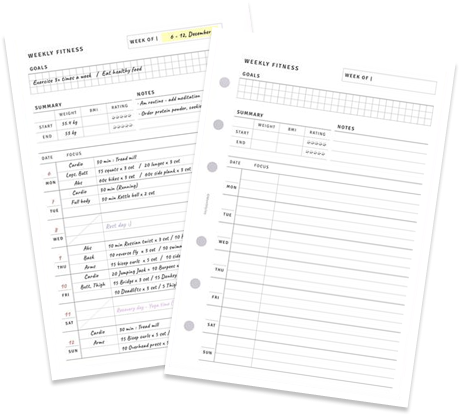
Building a week: three hard sessions, two easy sessions, one to two days fully off. If you only change one thing, make the day after your hardest workout an active recovery day instead of another tough one.
The bottom line
You don’t need more willpower. You need more room between the efforts. Recovery isn’t what happens when you stop training — it’s where training turns into results, and in perimenopause it needs more of the week than it used to.
This is exactly why I build my programs and workouts the way I do, and why our 8 week focus groups (like our current UNPAUSE program) feature a “Deload Week” within the program. More recovery equals more results, not the other way around. Interested in learning more? Join us in the BodyFit Athletic Club.
Give it two weeks. Most people are startled by how much stronger they feel on less.
This article is for general education and isn’t medical advice. Persistent fatigue, sleep disruption, or a sharp drop in exercise tolerance is worth raising with your healthcare provider.






Leave a Reply