

You used to take a set of stairs two at a time without thinking about it. Now you think about it. Exercises that you used to soar through now feel like you’re moving through quicksand. You find yourself groaning when you get up off the floor or out of bed.
Nothing is wrong with you. Something is changing in you — and the change is specific enough that you can train around it once you know what you’re looking at.
What’s actually happening
Estrogen does far more in the body than regulate a menstrual cycle. Muscle tissue is full of estrogen receptors, and estrogen helps with muscle repair, satellite cells that rebuild fibers after training, and how efficiently your body puts protein back into muscle. As estrogen becomes erratic and then declines through the perimenopausal years, that repair process gets less efficient. Androgen levels, including testosterone, have also been drifting down gradually since your twenties.
The practical translation: you can do the same workout you did five years ago and get less back from it.
Two things tend to go first, and they go in a particular order.
Power goes before strength. Power is force produced quickly — the push off the bottom of a squat, the hop off a curb, the catch when you trip on a rug, which is why we train for it with our swings, snatches, and plyometrics. It lives mostly in your fast-twitch (type II) fibers, and those fibers shrink first with age. This is why a woman can still lift a respectable weight but feel slow, heavy, and a half-second behind her own body.
Lean mass gets harder to hold. Age-related muscle loss — sarcopenia — isn’t a problem reserved for your eighties. It starts quietly in midlife, and the menopause transition appears to accelerate it. Muscle isn’t only about how you look. It’s your metabolic engine, your blood-sugar buffer, your bone’s best friend, and the reason you can get up off the floor at 75.
Here’s the part worth sitting with: none of this means you can’t build muscle in perimenopause. Research on resistance training in midlife and postmenopausal women is consistently encouraging. It means the stimulus has to be bigger and more deliberate than what used to work. Passive won’t cut it anymore. Intentional absolutely will.
Is this you? A quick self-check
Check every statement that’s true for you in the last 6–12 months:
- I’ve been doing the same weights for months — and they no longer feel hard, but I’m not seeing change either
- Something that used to be automatic feels slow: jogging to catch my kid, jumping, catching myself when I trip.
- Getting up off the floor or out of a low chair now takes strategy.
- My weight is roughly the same, but my body feels softer or less defined.
- Carrying groceries, a suitcase, or a toddler wears me out faster than it used to
- Most of my exercise is cardio — walking, classes, the elliptical — with little or no lifting.
- I’ve been lifting, but I honestly couldn’t tell you the last time I went heavier.
0–2 checked: You’re likely holding steady. Keep an eye on the boxes you did check.
3–4 checked: This is the classic perimenopause plateau. Your current training is maintaining you, not building you. The fix is load and intent, not more hours.
5+ checked: Muscle and power are your highest-return priority right now — ahead of cardio, ahead of anything else you’re considering.
What actually moves the needle
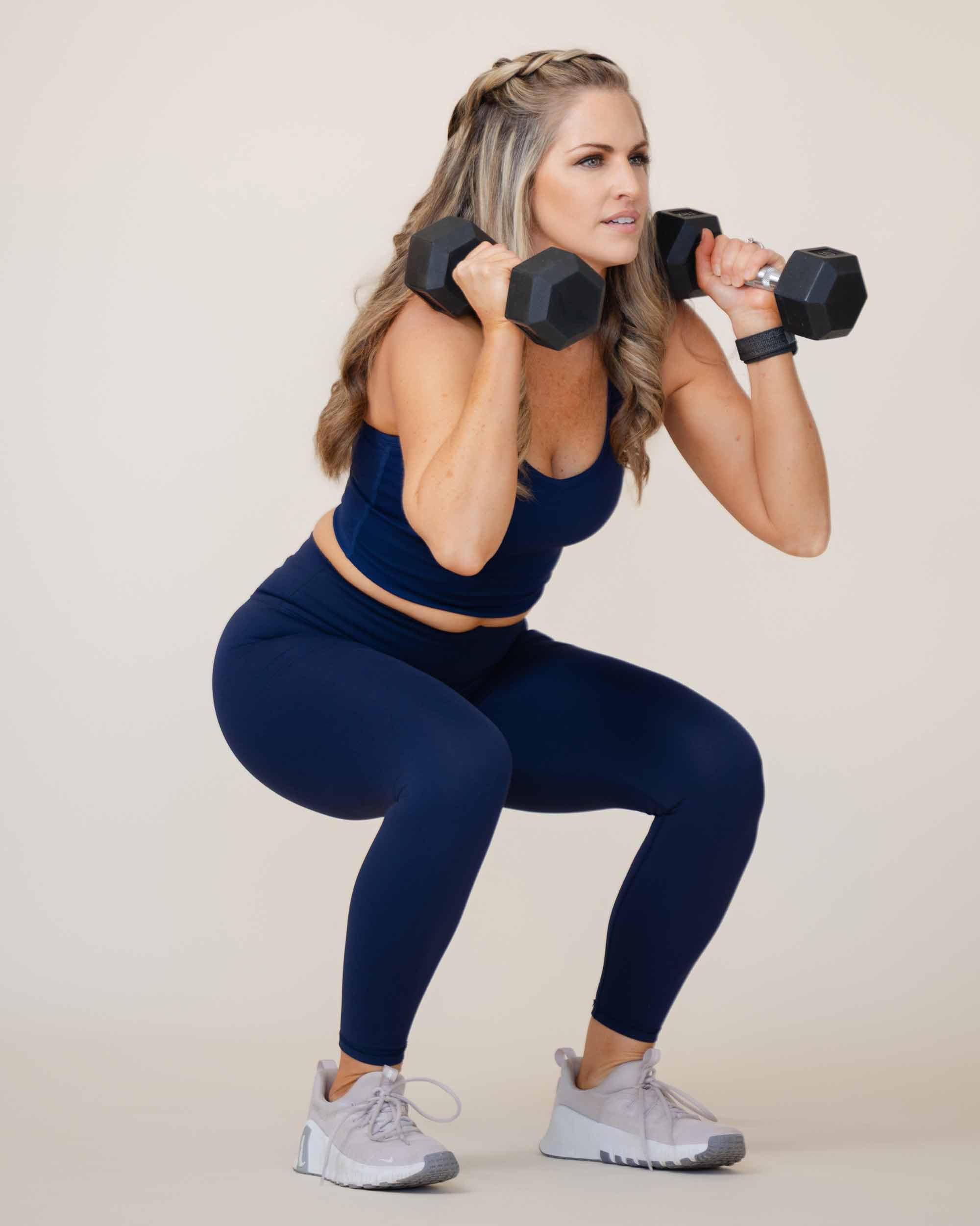
Lift heavier than feels polite. If you can do 15 reps and chat through them, that’s endurance work, not a growth signal. Aim for a weight where reps 6–10 genuinely challenge your form’s last rep. Most women in midlife are training several pounds below what they’re capable of, out of habit rather than ability. You’ve heard me say it before: If you’re wondering if it’s time to go heavier, it is!
Add intent, not just weight. Another thing you’ve heard me say: intention creates impact. I get it, some days all we can do is show up and go through the motions, and that’s okay– be where you are today, right?. But other days, most days, we can change the feeling of a workout simply by moving with intent. You don’t need to jump to train power. Lifting the same dumbbell fast on the way up and slow on the way down recruits the fast-twitch fibers you’re trying to keep. Think: press up quickly, lower with control. You don’t have to get 20 reps of an ab move, but if you slow it down and actively think about your core muscles contracting, you’ll feel it (and strengthen it) so much more.
Progress on purpose. Pick one thing to nudge every two to three weeks — a heavier set, an extra rep, a shorter rest. A couple reps of the higher version of a move: pushups on your toes, the full snatch versus a high pull, lower in a lunge. Muscle responds to change, not just to consistency alone.
Feed the work. Muscle protein synthesis becomes less responsive with age, which means protein timing and total intake matter more now than they did at 30. A solid protein serving with each meal does more for your lifting than any supplement will. Hint: We are discussing exactly this over in the BAC!
Two or three solid strength sessions a week beats five half-hearted ones. I know many of us like to move four, five, or six days a week for consistency and mental health. And active recovery, specific cardio, and mobility are so important! But when it comes to heavy strength, less done harder wins.
Three BodyFit by Amy workouts to start with
1. UNPAUSE: Full Body Strength for Menopause, Perimenopause & Beyond. Start here. It’s built specifically for a body in transition, and it’s the cleanest way to see where your current strength actually sits. Choose weights that make the last two reps of each set feel hard.
2. 34 Minutes Total Strength & Power with Weights: This is your fast-twitch work. The cue that matters: move quickly on the effort, control on the return. Do this one when you’re fresh, not at the end of a long day.
3. 25 Minute Bodyweight Power & Plyo: No equipment, and proof that power training doesn’t require a rack of dumbbells. Use this as your second or third session of the week, or on a travel day.
Building a week: two strength sessions plus one power session, with at least a day between the hard ones. That’s the whole prescription. Everything else is optional.
The bottom line
Your body hasn’t stopped responding to training. It has raised its standards. The women who come through the perimenopausal years feeling strong are rarely the ones who did more cardio — they’re the ones who picked up heavier weights and moved them with purpose.
Start with one workout this week. Pick the weight that makes you slightly nervous.


Leave a Reply