


Nothing about your eating changed. Nothing about your exercise changed. But your waistband did, and the things that used to work—going hard in your workouts, staying aware of nutrition, upping your core work—either don’t move the needle or make you feel worse without moving it. Often women jump right into restricting calories or overdoing the cardio, which is often not only ineffective; it’s exhausting for your body and your brain.
This is one of the most common and most frustrating experiences of perimenopause. It’s also one of the most misunderstood.
In my years of experience as a trainer, I know this experience is very real. And, as a woman in my mid-forties, I’m right there with you.
What’s actually happening
Let’s start by retiring a myth: your metabolism did not fall off a cliff at 45. Large studies of total daily energy expenditure suggest it stays remarkably stable from your twenties through about age 60, once you account for body composition.
I know. This is hard to hear. Personally (for me) and professionally (for my midlife clients), I know there’s comfort in feeling it’s not your fault. So let me be clear: it’s not your fault, no matter what the research says or the gym bros on social media claim. The changes you’re seeing and the hormone shifts you’re feeling are real. And research shows this isn’t because your metabolism tanks at a certain age. There’s more to it.
What changes isn’t a mysterious slowdown. It’s the composition itself, plus where your body chooses to store fat.
Fat redistributes. As estrogen declines, the body shifts fat storage away from hips and thighs and toward the abdomen — including visceral fat around the organs. This is why the scale can barely move while your clothes fit completely differently. It isn’t that you gained; it’s that inventory relocated.
Insulin sensitivity declines. Muscle is your largest site for taking up blood glucose. Less muscle and lower estrogen both reduce insulin sensitivity, making it easier to store and a bit harder to release fat—especially around the middle.
Your core and pelvic floor muscles are less responsive. As estrogen declines, tissue around your pelvic floor becomes thinner, elasticity decreases, and you feel more pressure from above. This can lead to leaking, weakness, instability, or even pain. You may even feel less connected or engaged during workouts or core exercises you’re used to.
The metabolic engine shrinks quietly. Starting in our 30s, our strength and muscle mass decline naturally, at a rate of 3-5% every decade. Every pound of muscle you lose lowers your daily burn slightly and substantially reduces your capacity to handle carbohydrates. Ten years of unnoticed muscle loss is the real “slow metabolism” most women are describing.
Here’s what follows from that, and it’s the whole point of this post: the strategy that addresses a composition problem is not the strategy that addresses an intake problem. Eating less and doing more cardio tends to cost you muscle — which is precisely the tissue that was protecting you. It works for two months and works against you for ten years.
Is this you? A quick self-check
Check every statement that’s true for you:
- My workouts are consistent, but my waist has changed
- Clothing fits differently through the middle
- The eating and exercise approach that used to work reliably isn’t working as well now
- I get noticeably hungrier, foggier, or more tired 1–2 hours after a carb-heavy meal
- I’ve been cutting calories, increasing cardio, or both — with little to show for it
- I do little or no resistance training
- I feel like I’m doing more than ever and going backward
0–2 checked: Likely normal fluctuation. Keep protein and strength work steady.
3–4 checked: This is the classic midlife composition shift. The lever is muscle and blood-sugar management — not a stricter diet.
5+ checked: You’re probably in a cycle that’s actively working against you. Changing the type of effort will do more than adding more of it.
What actually moves the needle
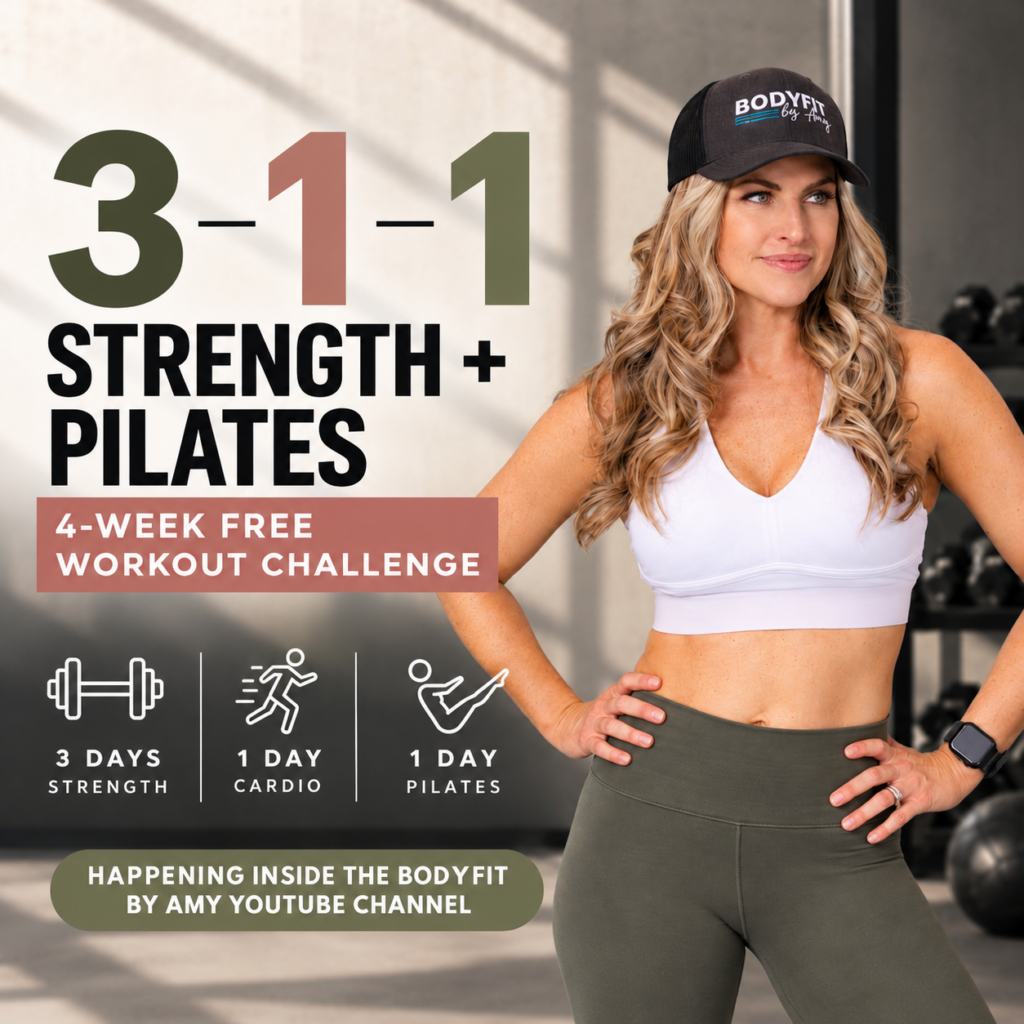
Make strength training the main event. If you have three days a week, spend at least two of them lifting. If you work out more, aim for three strength sessions per week, or hitting each muscle group at least twice. Muscle is the tissue that improves insulin sensitivity, raises daily burn, and changes your body composition. Cardio supports your heart and your head — it just isn’t the tool for this particular job.
Eat protein at every meal. It protects muscle while you’re changing anything else, blunts a meal’s blood-sugar swing, and is the single most reliable appetite regulator most women have never used on purpose.
Stop trying to solve this with a deficit. Aggressive restriction in perimenopause tends to cost muscle and raise the stress load at exactly the moment neither can afford it. Build first. Composition changes follow.
Give your deep core and pelvic floor the attention it deserves. For the core to respond and strengthen, we can’t ignore the basics. Deep core stability exercises like dead bugs and plank singles, plus pelvic floor activation, will help your abs respond with both strength and function. Forget the endless crunches and focus on the engagement.
Walk more and up your NEAT (Non-exercise activity thermogenesis). Everyday movement and reducing time spent sedentary—walking after meals especially—is unglamorous and genuinely effective for blood sugar. It also costs you nothing in recovery.
Judge progress by something other than the scale. I know, this is a hard one for all of us. Like I always remind you, the scale isn’t an accurate metric for your progress, yet I know in this stage of life, it’s hard not to think about changes and associate them with a number. Aim to stay focused on how you’re feeling, how you feel in your clothes, the weight on your dumbbells, your energy at 4 p.m., and the consistency you build with your workouts and movement! The scale is the least informative number in this particular story.
Be patient with visceral fat. It responds well to strength training and better blood-sugar control — but on a timeline of months, not weeks.
Four BodyFit by Amy workouts to start with
1. 35 Minute Total Body Strength Supersets: Your anchor session. Full-body, weighted, and repeatable — the kind of workout that builds the tissue doing the metabolic work. Go heavy enough that the final reps are genuinely hard.
2. 30 Minute Lower Body & Core Pyramid. Your legs and glutes are your largest muscle groups, which makes them your biggest glucose sink. Training them hard is as much a metabolic decision as a strength one.
3. 25 Minute Full Body Core HIIT: Your one higher-intensity session. Once a week is plenty — added intensity has real benefits, but a fourth hard day usually costs more in recovery than it returns.
4. Pelvic Floor & Deep Core for All: This quick no-equipment workout starts with alignment and breathing, then focuses on deep core strengthening and pelvic floor connection and engagement.
Building a week: two strength sessions, one higher-intensity session, daily walking and NEAT, and protein at every meal. That combination targets the actual mechanism.
The bottom line
The midsection shift isn’t a failure of discipline, and it won’t respond to being punished. It’s a change in how your body stores fuel and how much muscle you have to handle it—and both are trainable.
Put the weights back at the center of your week. The middle follows the muscle.
Looking for more guidance and support? Our UNPAUSE focus group in the BodyFit Athletic Club is covering all of this and more.
This article is for general education and isn’t medical advice. Sudden or unexplained weight change, or symptoms like persistent fatigue and excessive thirst, are worth discussing with your healthcare provider.








Leave a Reply